Weekly Dev Log
A short look at what I'm building on Rooted, posted every week. See all dev logs.
This week went across a lot of fronts: the first hostile enemies, a smarter camera, the inventory and how weapons and backpacks sit on your character, the wildlife and the world radio, the vehicle layer behind the boats, and the city itself starting to take shape. None of this is in the public build. It is all work in development.
The first enemies
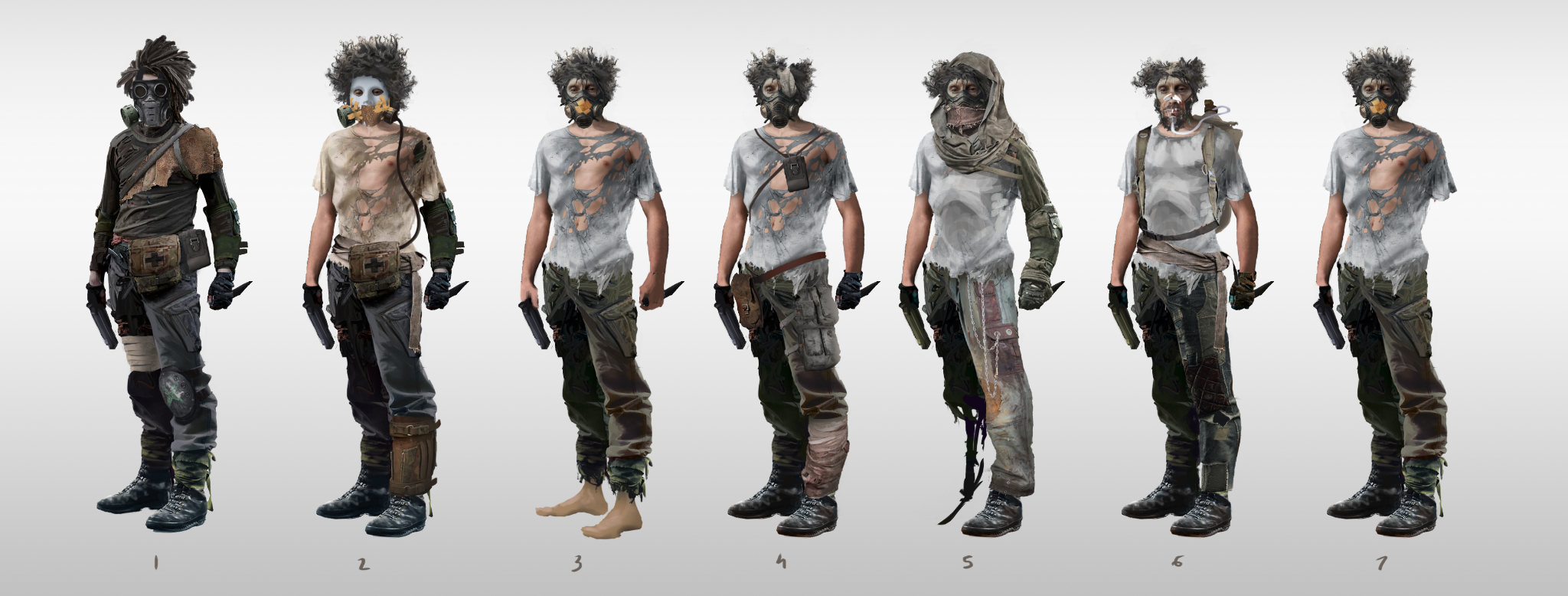
Most of my thinking this week went here. What I built is the foundation for the whole hostile cast: the systems that run them, the data that defines each faction and how it behaves, and a set of automated tests around it, all in place from the start. On that foundation the first hostile is already standing up: a feral survivor, one of the Frightened, that hides, holds, then erupts into a panicked, self-destructive burst when cornered. It shares its underpinnings with the animals, so I got something living and reactive without standing up a second AI stack.
The group layer is in too. When one member spots you, the whole group knows. They split work between holding you in place and pushing in from the side. Each group has nerve: take down the one anchoring it and that loss can ripple, the rest wavering, falling back, or breaking. Roles are part of it, so one runs for help, one peels off to grab loot, one hangs back as a lookout.
Because the factions and their behavior are authored as data rather than hard-coded, the way a group reads and reacts to you is something we tune, not something baked into the code. What is content, and authored separately, is the look, the animation, and the actual roster.
A camera with a mind of its own
The third-person camera is now a real, self-driving system. It reads the space around you and settles the framing on its own: a default over-the-shoulder feel, a tighter one when you aim, and an automatic pull-in when you are in a tight indoor space so the wall does not eat the shot. You can swap shoulders and the framing mirrors cleanly, with a slight inward angle so what you are looking at stays centered. When you take control of your character there is a short cinematic ease-in as the camera settles onto you.
The whole thing is data-driven, with the feel living in one place so it can be dialed without touching code. We are aiming for a high bar on the core character, camera and controls (the 3Cs), the feel you hold in your hands the whole game, and this camera is the start of that.
The inventory, and gear on your character
The inventory got a lot of attention, both on screen and underneath. You can merge stacks across your pockets and backpack, reorder slots and have that order stick per player, and split a stack with the middle mouse button. The backpack itself can be dragged out and dropped to the ground as a lootable bag. The panel sits over a softly blurred view of the live game, on a dark, muted palette.
Underneath, the way gear and backpacks work is built data-driven: a backpack, its capacity, and where each weapon sits on your body or your pack are defined as data rather than wired by hand, which keeps them open to change and to modding. Weapons ride on you when stowed, guns on the backpack, smaller gear on the body, drawn or put away with a tap. You carry a primary, a sidearm, and a melee at once and draw one at a time. I also built a small in-editor tool to place those stow points on the character precisely, and fixed a long-standing tilt in how the backpack sat on the body.
On the weapon side, reloading now pulls ammo from your pockets and your equipped backpack, the aiming reticle steps back to a clean loading ring during a reload, and the spread kicks per shot so holding the trigger no longer drifts back to center on its own.
A world that reacts
The animals now sense you for real, and it runs on the same data-driven, tested base as everything else. They see within a forward cone with a clear line of sight, and they smell you on a range that shifts with the wind, so coming in downwind matters. Cross their threshold and they flee, sprinting away until they feel safe. They also actually show up now, each wearing its species model and standing properly on the ground, where before they rendered as nothing.
The world radio is the one I am most curious to see played with. Speakers placed in the world voice whatever station they are tuned to, kept in sync so everyone in co-op hears the same thing at the same point, with scheduled programming that picks messages by weight and time of day and audio that degrades like a worn transmission. It is built as a general broadcast layer: anything can emit on a frequency, and anything can listen on it. That opens a lot of room for emergent moments around what is on the air and who controls it, and the programming itself is authored as data.
The weather is now something that moves through the world rather than a global switch. Storm cells spawn upwind of players, drift downwind, ramp up, and dissipate, so a storm is a place you can be inside of or outside of. The radio audio clips are content I still need to author, and the storm visuals are early.
The vehicle layer
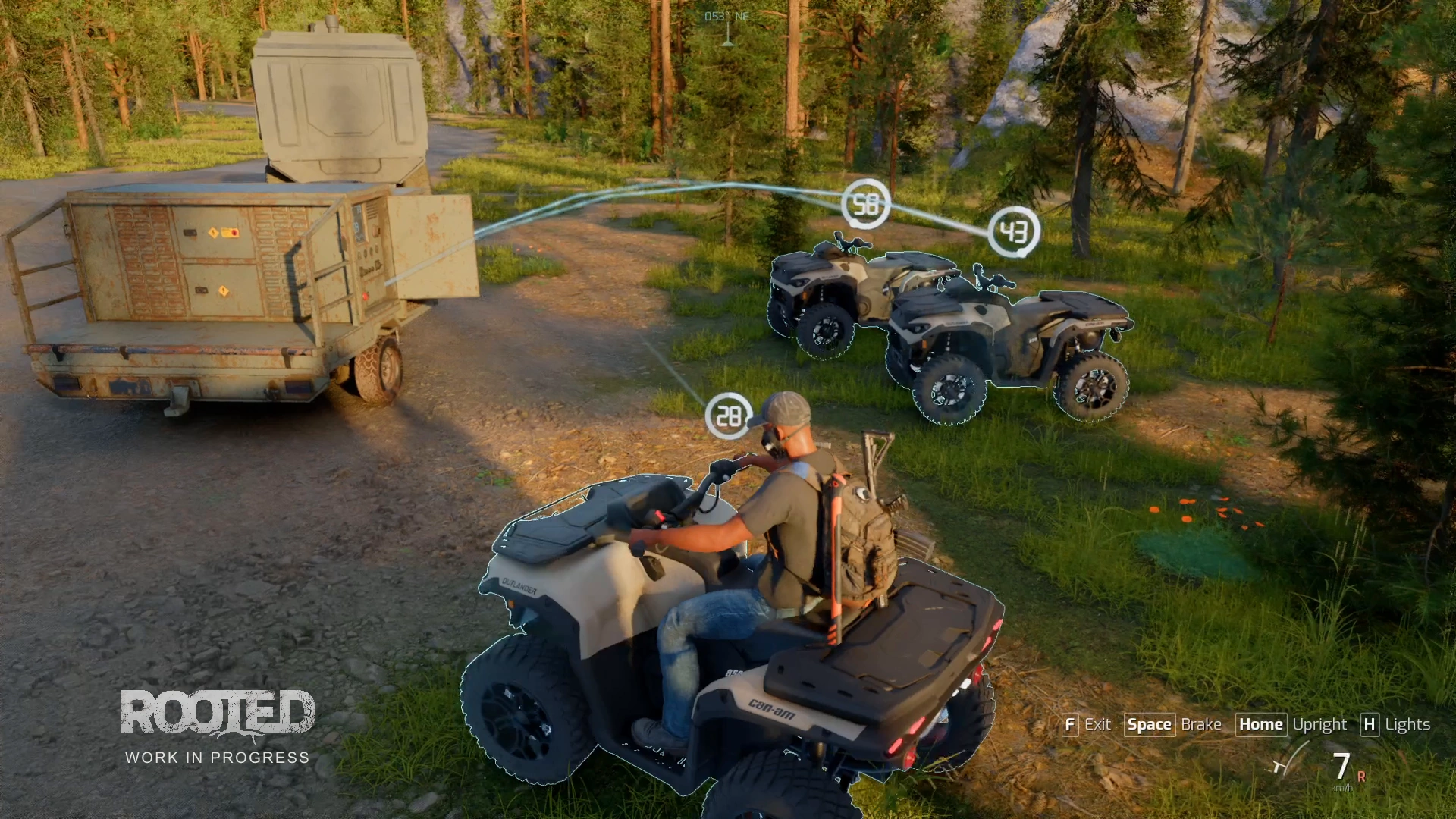
The boats are really the first thing exercising a broader vehicle layer, and that is where the work went. A vehicle is described as data, its seats and the roles on them, and a second player can now ride as a passenger with their own seat, not just drive. The driving and exiting paths are solid in co-op now, after running down a cluster of issues that only showed up with a real second player connected: a joining player can take the wheel, steer, and step off cleanly. When the driver leaves, the seat releases and the boat coasts to a stop instead of locking up. There is also an interim water surface so a boat floats and drives on the water plane while the full water hook-up comes together.
Building the city
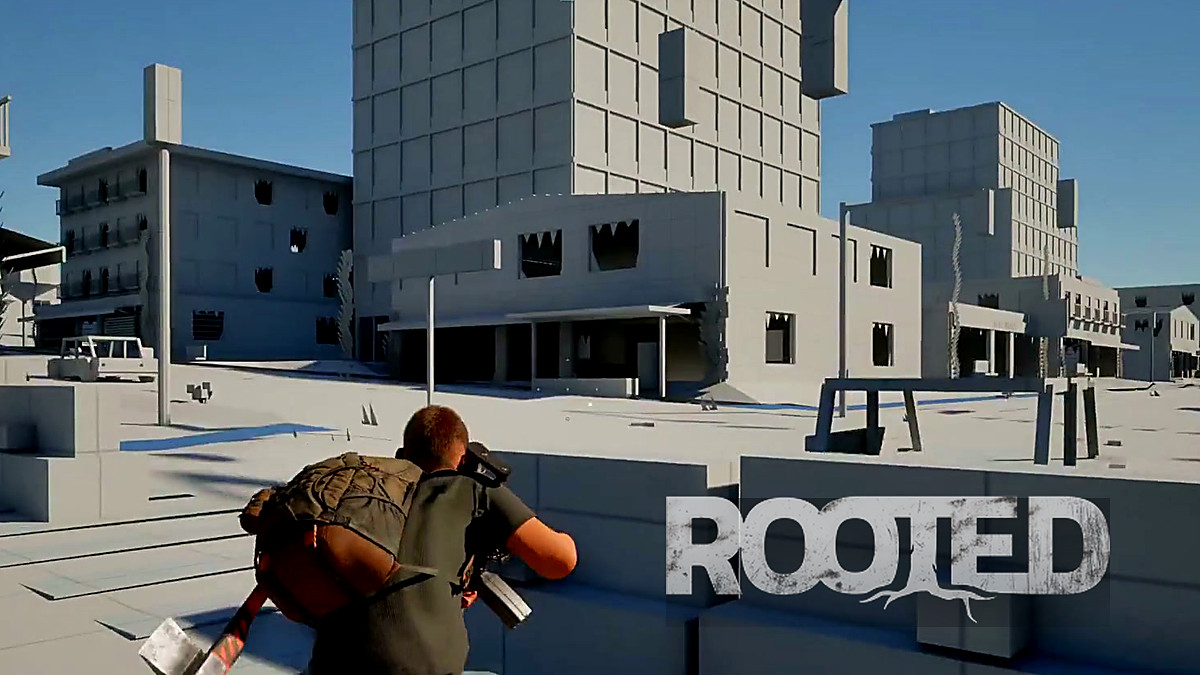
Away from the code, a lot of craft is going into the city itself: art, design, and procedural R&D for how a dense, overgrown town comes together. The road network is the furthest along, the layout and the rules that lay roads down and dress them out, which is the backbone the rest of the urban space hangs off. This is the world-building side of the project rather than a system you switch on, and it is well advanced.
Also this week
- Workbench - the in-game crafting bench now has a full-screen layout with live recipe requirements, an output bay to collect what you craft, tier progress at a glance, and a moody backdrop.
- Sleep and time - an intelligent layer for time and rest: a single canonical clock the world runs on, sleeping that ties into where you respawn, and rest that feeds back into your character's health.
- Compass - a HUD compass with a procedural band and a needle that eases with a bit of inertia, reading a precise bearing while the band catches up.
That is the week from the development side.
Mat
Comments
Join the conversation. Log in to comment and react.
Log inNo comments yet. Be the first to share.
Wishlist on Steam
Don't Miss Launch
Get notified the moment we launch, and be among the first into Early Access.
Wishlist RootedJoin 1M+ players who've already wishlisted Rooted